
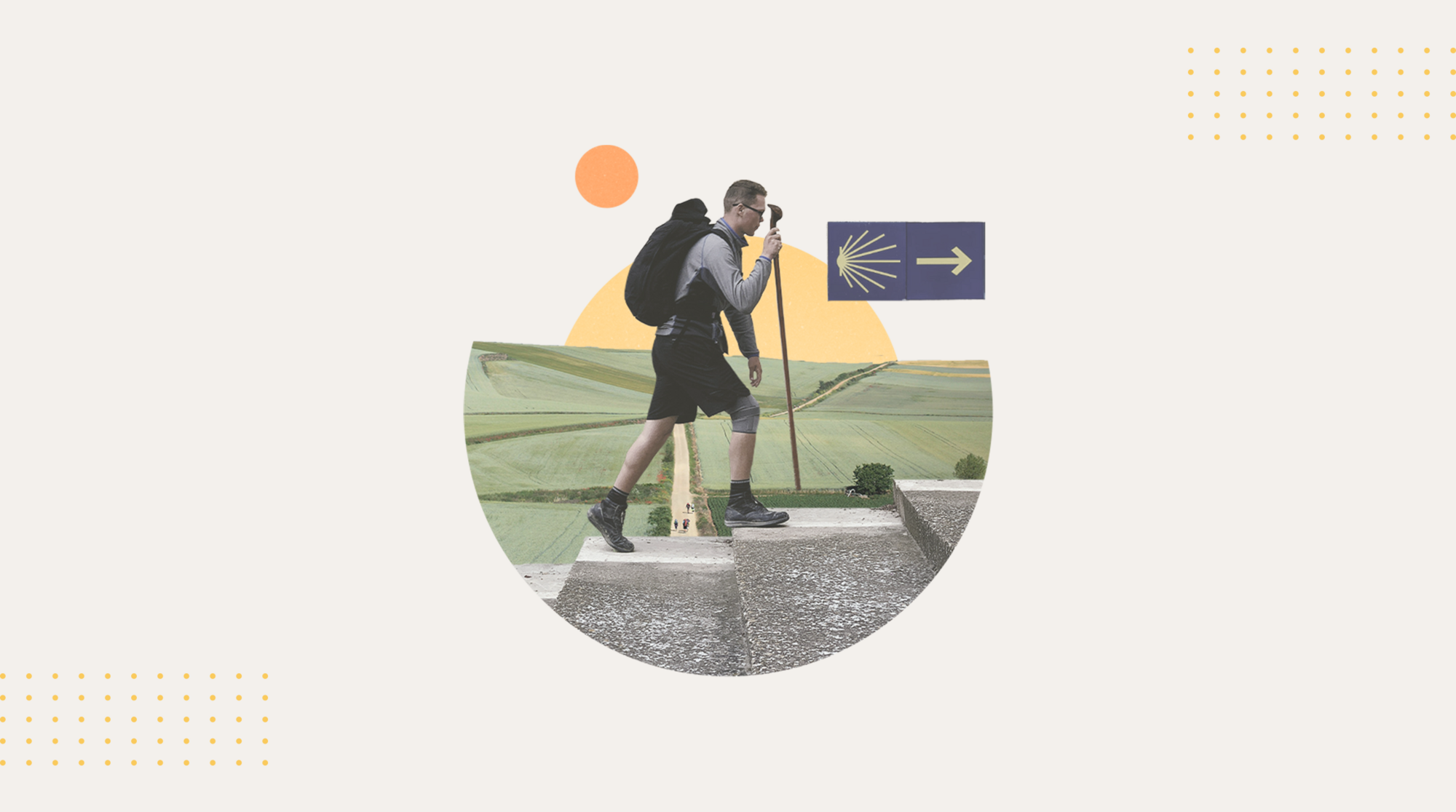
A hike is a hike, right? Not when it comes to the Camino de Santiago.
But what exactly is the Camino de Santiago? The short answer is that it's an epic adventure across Spain on foot.
The more detailed and accurate answer, however, is a much longer and more complex story that started over a thousand years ago.
And for anyone interested in trying some of the best adventures this planet has to offer, its a story worth digging into.
So, grab your hiking boots, tie your laces and come on a trek with me through the ins and outs of the Camino de Santiago and why everyone should have this journey on their travel priority list.
reality, its background, history and evolution through the ages
Whether you're in it for the views, the food, or the sheer sense of achievement, this ancient pilgrimage is well worth it.
Taking on the Camino is not your standard walking holiday.
Why Walk the Camino de Santiago?
The Camino can be a great bringer-togetherer. Bt it also divides opinion.
For many who take it on, the Camino de Santiago is a spiritual experience, ...pilgrimage, deprivation, uncomfortable, exercise in frugality and deprivation, testing the self etc. challenge and a rite of passage. Most of all, its valued as an ancient pilgrimage designed to make you stop and appreciate the world around you and contemplate your place in it.
However, over time, its seeped out of the spiritual world and into travel and tourism. Traelers of today have embraced it and adapted it to make it less deprivation and hardship and more fun.
For many travellers in 2025, taking the Camino de Santiago is about the much simpler business of good times.
For them, it's no more serious than a break, for getting out into nature, for making friends for life. And to imbibe the incredible scenery, food, drink and camaraderie that can be had in North Spain.
My Camino - a Reflection
When I walked a section of the Camino de Santiago in 2022, I was part of the latter camp.
A friend and I made our way from Bilbao to Santander along the beaches of North Spain.
Our days were filled with finding and following the famous blue and yellow shells, hiking, sleeping, more hiking and repeating daily.
We filled spare moments meeting travellers, basking in April's rays, strumming guitars and picking at pintxos.
The slower, more contemplative pace of Camino life is intoxicating.
It makes returning to the inertia of order and routine feel like a life-questioning tragedy.
But, like any trip, return we did. And ever since, we've been singing the virtues of the camino to anyone who'll listen. As well as insisting that this is a trip you have to take at least once in your lifetime.
This legendary pilgrimage route has been drawing adventurers, spiritual seekers and ambitious walkers for over a thousand years.
Whether you’re after spiritual enlightenment, a good old-fashioned adventure, or just want to see if you can survive 30 days of walking in the Spanish heat, this ancient pilgrimage has something for everyone.
What is the Camino de Santiago?
At its core, the Camino de Santiago (or the “Way of Saint James”) is a network of walking routes leading to Santiago de Compostela in northwest Spain, where the remains of Saint James are supposed to be buried in the city's cathedral.
The pilgrimage dates back to the Middle Ages, when Europeans would trek for months to visit the sacred site, often as repentance or to secure their spot in the afterlife.
Today, it's more about the joy of the journey. Some people do it to find themselves. Others do it to find some top-quality Spanish wine along the way.
What is the History of the Camino de Santiago?
Before diving into the routes, let's nip back in time. The story goes that after Saint James was beheaded in Jerusalem in 44AD, his remains were somehow transported to the Iberian Peninsula.
Fast forward to the 9th century, when a hermit named Pelayo supposedly discovered the apostle's tomb after following a field of stars (hence "Compostela" – field of stars).
A chapel was built over the site, and word spread across Europe. Soon, pilgrims from all corners of the continent were making the journey and a network of paths was born.
By the 12th century, the Camino was in full swing, with thousands trudging annually to Santiago.
What is the best Camino de Santiago route?
The camino de Santiago isn't just one route to the city. It's a network of walking paths ....
Camino Francés
The French Way is one of the most popular Camino routes. Stretching approximately 780km from Saint-Jean-Pied-de-Port in France, it's the route most pilgrims dream about.
The route crosses the Pyrenees (with enough scenic views to busy your Instagram feed for the rest of the year), before passing through Pamplona (of bull-running fame), the gorgeous wine region of La Rioja, and the open plains of Castilla y León. It's basically a greatest hits tour of northern Spain.
Camino Portugués
Starting from Lisbon or Porto, this route is a postcard come to life. At 260-620 km (depending on your starting point), it's shorter than the French Way but packs just as much punch.
The coastal variant is particularly gorgeous, taking you along Atlantic beaches where you can dip your tired toes in between walking sessions. It's also flatter than some other routes, which your quads will appreciate after a week on the trail.
Top tip: the Portuguese really know their pastries, so prepare for some seriously good mid-hike snacking.
Camino del Norte
A coastal route that'll test your fitness and reward you with some of the most breathtaking landscapes in Spain. About 825km of pure adventure, this one’s perfect for those who think regular holidays are for wimps.
Following Spain's northern coast through the Basque Country, Cantabria, Asturias, and finally Galicia, it's a highlight reel of spectacular seascapes and mountain views.
The Norte is less crowded than the Francés and often has weather that'll remind British walkers of home. Pack your waterproofs and embrace the moody, dramatic coastline views that often come with a bit of rain.
Camino Primitivo
The granddaddy of Camino routes. Roughly 310 km of rugged terrain that'll make you feel like a proper explorer. Less crowded, more challenging, and guaranteed to give you stories that'll impress your mates for years to come.
This is said to be the original Camino route, taken by King Alfonso II himself back in the 9th century.
It's a bit of a beast, with serious mountain sections and fewer services, but the payoff comes in the form of magnificent landscapes and an authentic feeling that's harder to find on the more popular routes.
Why Walk the Camino de Santiago?
Epic Views: Forget your fancy screensavers. The real-life landscapes you’ll encounter along the way will have your jaw on the floor.
Foodie Heaven: Tapas, pintxos, Galician octopus… Your taste buds are in for a treat. This is Spain, after all.
Personal Growth: The walk itself is an achievement, but it’s more than that. People say that once you’ve completed the Camino del Santiago, you won’t return home the same person. Whatever your reason for doing it, you’re bound to learn something about yourself that you didn’t know before you set off.
Global Community: The Camino attracts people from all walks of life and every corner of the globe. The pilgrimage is a great way to meet new people and break down social barriers. There’s nothing like sharing blisters and bunk beds with complete strangers. Many people say the highlight of their trip is the people they meet along the way.
Practical Bits
Where to Stay
Albergues are communal and affordable pilgrim hostels along the Camino de Santiago routes. They mostly offer basic bunk beds in dormitories, and operate on a first-come, first-served basis. They range from facilities run by local councils to private albergues with a bit more comfort.
For those who value their sleep or privacy, there are also plenty of small hotels, guesthouses and rural B&Bs along most routes. Just be prepared to book ahead in high season (May-September) if you're not keen on dorm living.
How Long Does the Camino del Santiago Take?
Most pilgrims tackle the popular Camino Francés route in 30-35 days, walking about 20-25 km daily. But there's no right or wrong way to do the Camino. Some people knock out 40km days and finish the Francés in three weeks, while others take a more leisurely pace, stopping to explore towns or take rest days.
You can also break it up into sections across multiple trips if you can't take a month off work all at once. The Camino will wait for you – it's been there for a thousand years.
Short on time? The final 100 km from Sarria still counts for your official Compostela certificate.
Pro Tips
Train in Advance: Your legs will thank you later. Even if you're reasonably fit, it’s a good idea to start with some long weekend walks carrying your backpack and breaking in those hiking boots properly.
Pack Light: Remember, you're not trekking through the wilderness. There are shops along the way for anything you might need. Your shoulders will thank you.
Stay Connected: An eSIM for Spain is your digital lifeline. The days of pilgrims navigating solely by yellow arrows are giving way to tech-assisted journeys. With an eSIM from Airalo, you'll avoid racking up expensive roaming charges while still having access to maps, translator apps, and other electronic essentials.
Embrace the Unexpected: Rain, sun, mud, noisy bunkmates – it's all part of the adventure. Some of the best Camino memories come from the unplanned moments. The Camino has its own rhythm and rewards those who can go with the flow rather than sticking rigidly to an itinerary.
Learn Some Spanish: While you can get by with English in most places, knowing basic Spanish phrases will enrich your experience tremendously. Locals appreciate the effort, and it'll help you connect with Spanish pilgrims, who make up a significant portion of Camino walkers. Even just "por favor," "gracias," and "una cerveza, por favor" (a beer, please) will get you surprisingly far.
Stay Connected with an eSIM for Spain
Looking for the best eSIM for Spain? Grab a Spain eSIM from Airalo and ensure you're never lost, disconnected, or without social media. Track routes, find water stops and share your epic journey in real-time.


